![[LED Display Color Calibration Guide] How to Set Color Accuracy for the Large LED Video Wall?](/media/tmp/webp/page/40f9e1d6133ef9de065b0bc5927be755.webp)
Modern LED display installation prioritizes streamlined deployment and long-term reliability.
Whether installing a standard LED wall mount or a flexible LED display, success depends on three critical factors: structural precision (accurate frame leveling), efficient heat dissipation, and robust signal redundancy to ensure a high-definition visual experience.
Choosing the right mounting style depends on your architectural environment and audience engagement goals. Below is a comparison of the primary methods used for professional LED screen panels:
| Method | Best Use Case | Recommended LAMPRO Series |
|---|---|---|
| Wall-Mounted / Surface Mount | Corporate lobbies & retail branding | BNX II / LS Pro Series |
| Hanging (Suspended) | Concerts, trade shows, & temporary events | RN II / LRS (Rental) Series |
| Embedded (Recessed) | High-end architectural integration | LMini / LHP Series |
| Pillar / F-Frame | Creative outdoor & roadside video ads | LST / LXⅡ Pro (DOOH) Series |
Before the first module is attached, the "pre-work" determines the final image quality. A LED display installation is only as good as its underlying structure.
The steel structure or mounting bracket must be perfectly level, typically within a tolerance of ±1mm. Even a slight deviation will cause "dark lines" or "bright seams" where modules meet.
When configuring a 2x2 LED flat panel surface mount, installers must perform a wall-load bearing check. Because these panels are often installed in high-traffic corporate areas, using high-precision laser levels is essential to ensure the four panels align into a single, perfectly flat canvas without physical gaps.
→ Click to watch LAMPRO LMini Installation Guide
Modern architecture often demands curves rather than flat surfaces. Installing a flexible LED display requires a different logic than standard cabinets.
Specialized installations utilize magnetic suction tools. This allows for "Front Service" maintenance, meaning modules can be popped out from the front without dismantling the entire rear structure.

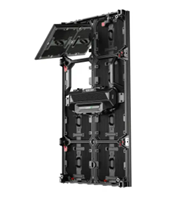
LAMPRO’s flexible modules are engineered to bend into organic shapes. The installation logic focuses on "soft" PCB technology that allows for tight-radius curves without creating visible gaps between the segments, maintaining a continuous 4K image flow.
A professional LED flat panel surface mount requires organized "Daisy Chain" wiring to ensure stability and ease of troubleshooting.
Once the hardware is mounted, the software configuration ensures the LED display installation performs at its peak.
For a LED flat panel surface mount, a minimum of 10cm (4 inches) is recommended if the unit is not "front-venting." Proper airflow prevents heat buildup, which can degrade LED lifespan over time.
Yes, but only with reinforced backing. Because LED screen panels are heavy, the wooden studs must be located and reinforced with a steel sub-frame to distribute the weight safely.
This depends on the load rating of the truss and the "Hanging Bar" specifications. For LAMPRO Rental series, typically up to 10-15 meters is safe, provided the structural safety factor (usually 5:1) is met.
→ To determine the LED screen size and ratio
A successful LED display installation is a blend of mechanical precision and software expertise. By prioritizing level frames, redundant cabling, and proper "soft start" commissioning, you protect your investment for years to come.
Explore our BNX II Series for easy-access wall mounts, or contact LAMPRO today for a custom installation blueprint tailored to your project.
↑![[2026] Latest LED Display Installation Guide: From Flexible Screens to Surface Mounts](/media/tmp/webp/page/aa997566c8aede107e2798099556edfc.webp)
![[2026 Guide] How to Protect Outdoor LED Screen Panels from Snow & Low Temperature?](/media/tmp/webp/page/05675b27a8ddfb965afeeae5e67de435.webp)


